Your case is the one decision you can’t easily fix after the fact. Unlike thermal paste, which you can swap out in twenty minutes, or a cooler that unclips with a screwdriver, a case defines your airflow path, your radiator options, your cable routing geometry, and — quietly — your sanity during every future upgrade. A mid-tower case is the most common form factor: big enough to fit a standard ATX motherboard, a full-length graphics card (GPU), and a 360mm AIO (all-in-one liquid cooler — a self-contained pump, radiator, and fan assembly), yet small enough to sit on a desk. If you’re reading this because you have a build in progress and you’re trying to decide whether the case you’re eyeing will actually do what the product page claims, you’re in the right place. We’ve combed published reviews, manufacturer spec sheets, and aggregated owner reports to give you a clear decision frame: tradeoffs named, compatibility claims attributed, math shown.
| EDITOR'S PICK[NZXT H5 Flow 2024](https://www.amazon.com/dp/B0D2MK6NML?tag=greenflower20-20) - Compact ATX… | Mid-tier[ASUS Prime AP201](https://www.amazon.com/dp/B0B99HTD3B?tag=greenflower20-20) Micro ATX PC C… | Budget pick[Thermaltake View 270 Plus](https://www.amazon.com/dp/B0CCXHZBSV?tag=greenflower20-20) TG AR… | |
|---|---|---|---|
| Motherboard Support | ATX | Micro ATX | E-ATX |
| Max GPU Length | — | 338mm | — |
| Radiator Support | 360mm Front, 240mm Top | 360mm | 360mm |
| Included Fans | 2 x 120mm | 1 x Pre-Installed Fan | 3 x 120mm ARGB |
| Side Panel | Tempered Glass | Tool-Free Mesh | Dual Tempered Glass |
| PSU Form Factor | — | ATX | — |
| Price | $79.99 | $71.24 | $56.51 |
| See on Amazon → | See on Amazon → | See on Amazon → |
How We Ranked These Cases — and What “Cooling-Focused” Actually Means
A cooling-focused mid-tower earns that label by satisfying at least three criteria simultaneously: (1) enough fan mount positions to create a genuine front-to-back or bottom-to-top pressure airflow path, (2) radiator support at 360mm on at least one axis without component conflicts, and (3) cable routing channels deep enough that bundled cables don’t choke airflow behind the motherboard tray. A case that scores well on only one of these is a compromise, not a solution.
The cases ranked here — the Corsair 4000D RS ARGB, ASUS Prime AP201, NZXT H5 Flow 2024, Thermaltake View 270 Plus, Lian Li V100, and be quiet! DARKROCK EC2 — represent the range from $70 to $200 where most deliberate builders shop in mid-2026. Each one has a clearly defined “if X, then Y” role explained at the end of this article.
Case-by-Case Breakdown: Tradeoffs Named
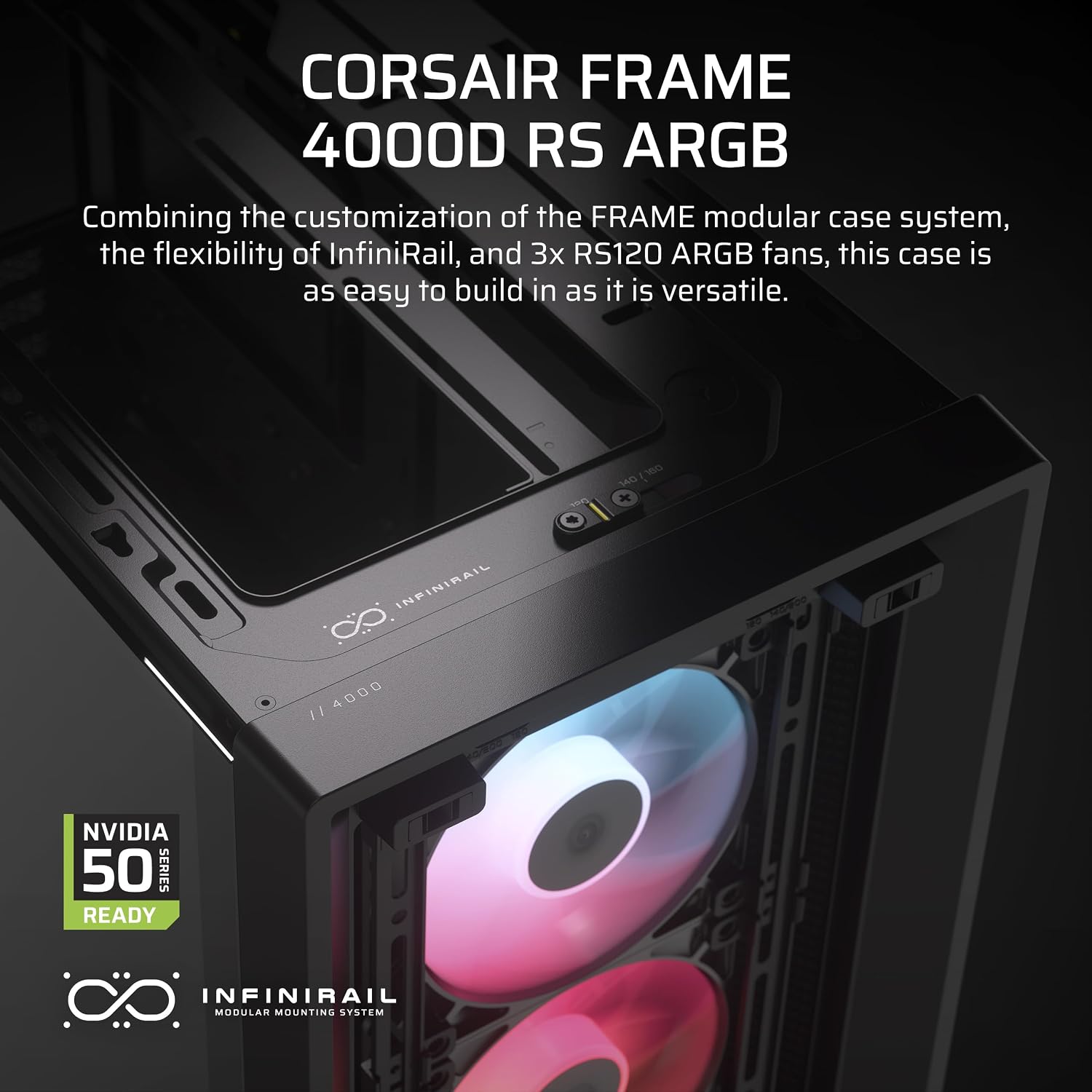
Corsair 4000D RS ARGB — Best Overall for 360mm AIO + Full-Length GPU Simultaneously
The 4000D RS is the case that reviewers at Tom’s Hardware (Best PC Cases roundup, 2025–2026 edition) return to when the question is “can I fit a high-end GPU and a 360mm radiator without compromising either?” The front panel accommodates a 360mm radiator, and GPU length up to approximately 400mm is supported simultaneously — a genuinely rare combination at this price tier.
What makes this possible is Corsair’s internal geometry: the case is wider than a traditional mid-tower footprint, giving the GPU enough lateral clearance to coexist with front-mounted radiator fans. Owners consistently report that cards in the RTX 4080 Super class sit with comfortable clearance when a 360mm radiator is front-mounted. These are self-reported owner fit confirmations, not editorial measurements.
The “RS” suffix denotes the reversed-connection layout — the I/O spine faces the opposite side panel, so cable exits go right instead of left. The RS layout works with standard non-reverse ATX motherboards, but the visual payoff is maximized when paired with a reverse-connector board. KitGuru’s 2025 coverage of the Corsair RS lineup confirms standard ATX compatibility explicitly. If you’re using a conventional board, the cable management geometry still works; it’s just less dramatic.
The tradeoff: The RS layout requires deliberate planning for front-panel header routing. Builders who plug headers without accounting for the reversed geometry first consistently report regretting it during the second build phase.
ASUS
$71.24
In stock on Amazon
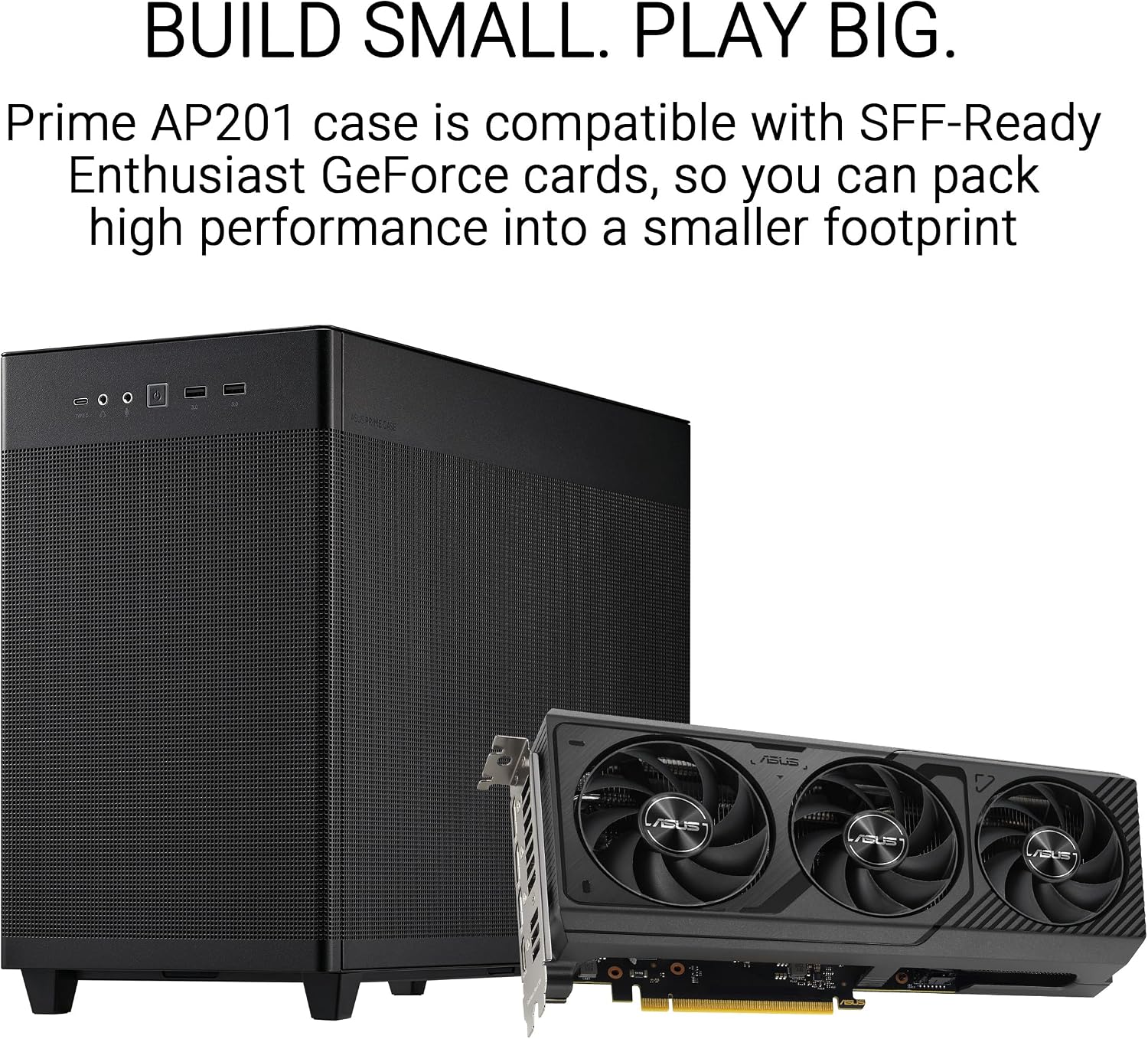
Check price on AmazonASUS Prime AP201 — 360mm Radiator in a Micro-ATX Footprint
This is the case that earns genuinely surprised language in owner reviews, and for good reason. The AP201 is classified as a Micro-ATX mid-tower, and the combination of small footprint and 360mm radiator support sounds implausible until you study Asus’s internal layout. PC Mag’s Best PC Cases for 2025 roundup flags this as the AP201’s headline achievement among compact builds.
The critical caveat: “fits a 360mm radiator” means 360mm on the top panel. Front panel support is 240mm maximum. So if your thermal plan requires front intake with the AIO radiator at the front — the conventional high-performance path — the AP201 forces a compromise: either relocate the radiator to the top (which works thermally if you account for heat exhaust interacting with RAM and VRM zones) or downsize to a 240mm AIO.
Owners who treat this as a top-exhaust AIO case report excellent results. The question you need to answer before purchasing is whether your specific AIO performs adequately in top-mount exhaust orientation — most 240mm and 360mm units do, but push-pull configurations may require fan header extension cables that the AP201’s cable routing doesn’t make obvious.
The tradeoff: You’re trading front-intake radiator flexibility for a dramatically smaller desk footprint. If size matters and 360mm top-mount is acceptable, there is nothing else in this footprint class that competes.
Thermaltake
$56.51
In stock on Amazon
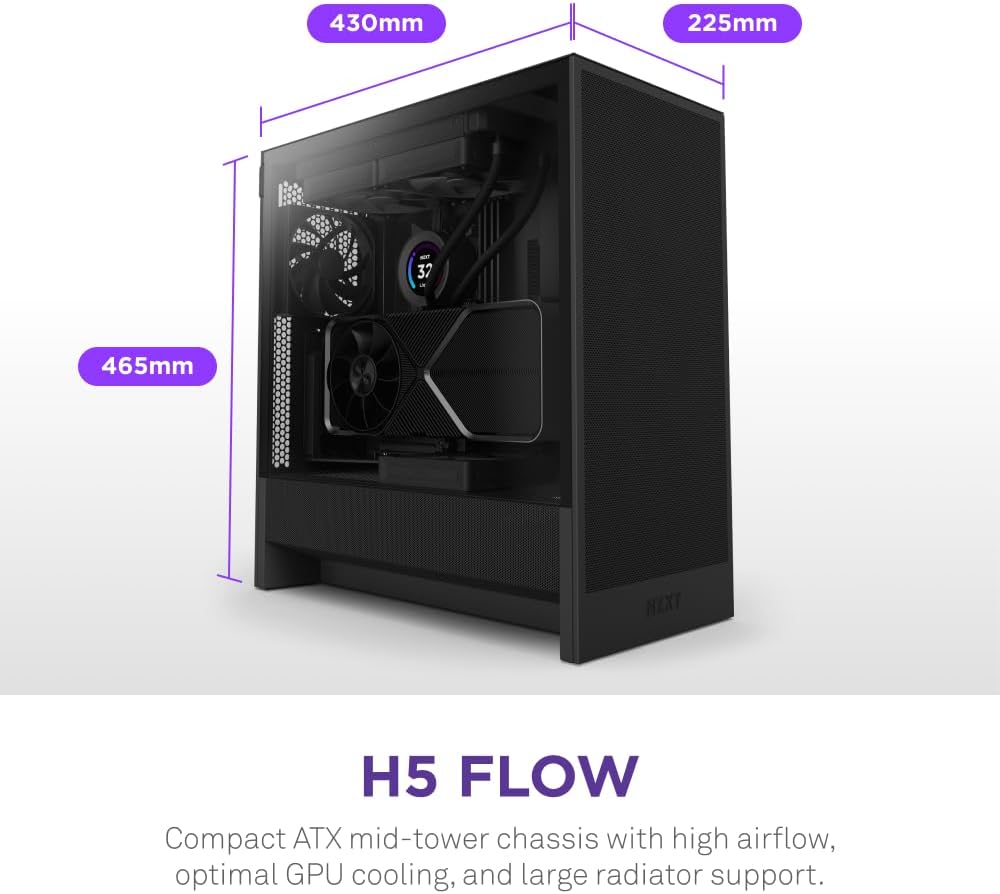
Check price on AmazonNZXT H5 Flow 2024 — Best for First-Time Builders Working Alone
The H5 Flow’s reputation is built on two recurring themes: airflow that punches above its price, and a building experience that doesn’t require a second pair of hands or a tutorial running on a second screen. Overclock3D’s NZXT H5 Flow 2024 review highlights the mesh front panel’s effectiveness and the cable routing channels as genuinely builder-friendly rather than marketing-friendly.
What’s less discussed is the dust filter situation, which owners mention almost as often as the airflow itself. The H5 Flow ships with dust filters on the front intake and bottom PSU area. Owners who have run the case for six to twelve months report that filter cleaning is straightforward — pop out, rinse, reinstall — and that the filters meaningfully reduce internal dust accumulation compared to mesh-only designs they’ve previously owned.
Radiator support: 360mm on the front, 280mm on the top. That’s a legitimate high-performance configuration for an Intel Core i9-13900K or AMD Ryzen 7 9800X3D build without modification.
The tradeoff: The H5 Flow is not the choice for elaborate ARGB setups. The tempered glass side panel shows the interior cleanly, but the case has no integrated lighting ecosystem. If aesthetic parity with performance is a requirement, the Thermaltake or Lian Li options below are worth examining.
ASUS
$71.24
In stock on Amazon
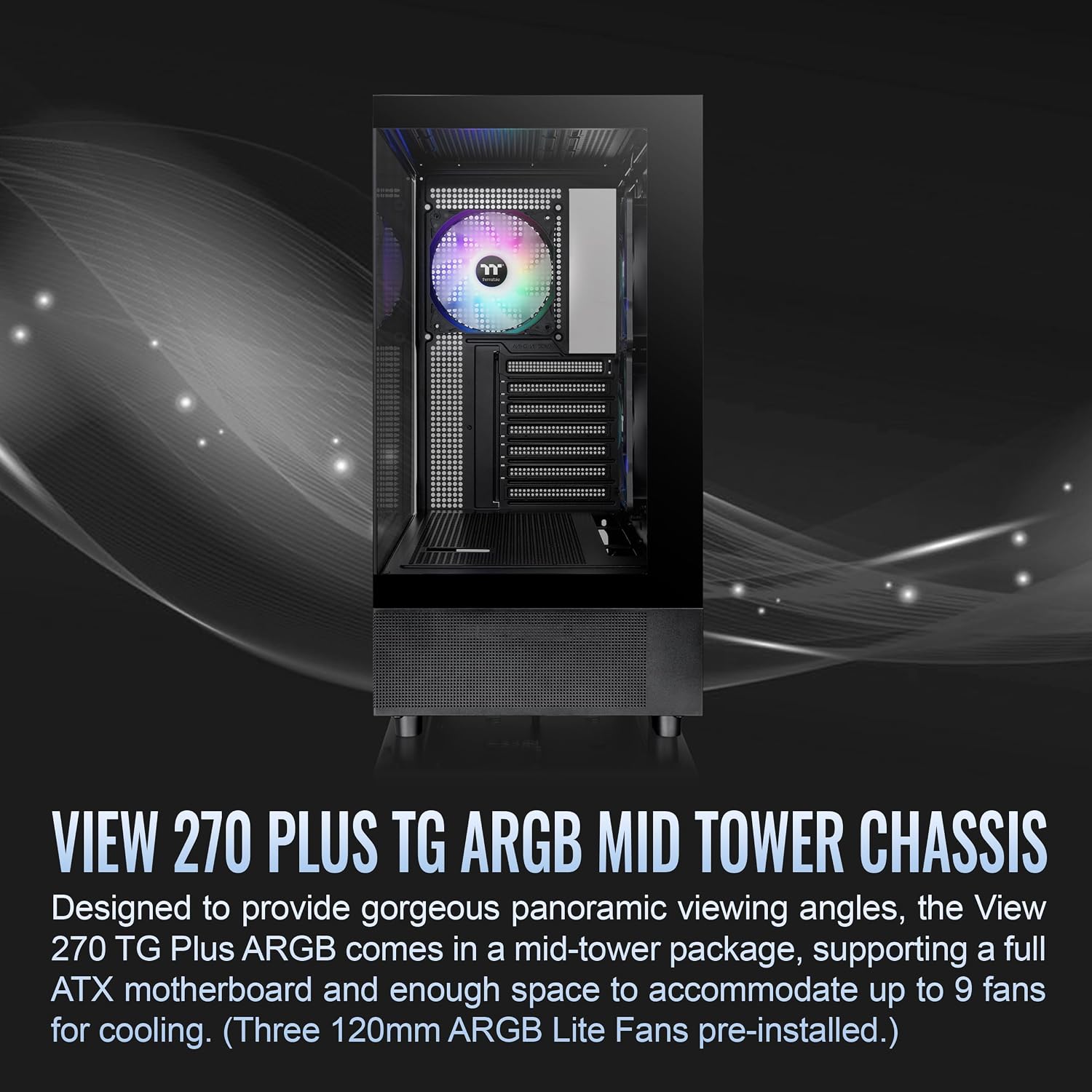
Check price on AmazonThermaltake View 270 Plus — Most Enthusiastic Owner Language in This Category
The comparison that keeps appearing in owner coverage of the View 270 Plus is that the included accessories make the case feel like it ships with more than it should — dual tempered-glass panels, ARGB fans included, cable routing described by owners as genuinely thought-out, all at a price that undercuts comparable Corsair and NZXT configurations.
The included fans — typically a 200mm front intake and 120mm rear exhaust in the standard configuration — are a genuine question for performance builders. The short version: owners running sustained workloads report that replacing the 200mm front fan with a premium aftermarket unit such as a Noctua NF-A20 or Arctic P20 meaningfully reduces noise at equivalent airflow. The stock fans are not the embarrassments that budget-case fans often are, but they are not optimized for near-silent builds.
Radiator support is front 360mm, top 360mm — one of the most generous layouts in this comparison set. Hardware Luxx’s mid-tower airflow case roundup for 2025 identifies dual 360mm radiator support as a differentiating feature at this price tier.
The tradeoff: The dual-glass panel design imposes an aesthetic constraint. You’re committing to a display build. The View 270 Plus looks awkward if the interior isn’t cable-managed, because both sides are visible.
ASUS
$71.24
In stock on Amazon
Check price on AmazonLian Li V100 — Pre-Wired From the Factory
The V100’s standout claim — pre-wired fan and RGB headers, factory-routed, before you put a single component in — sounds like marketing copy. Owner reports aggregated across hardware coverage and retailer reviews consistently confirm it: the V100 arrives with its included fans already connected to an internal hub, cables already routed behind the motherboard tray. The practical effect is that a first- or second-build enthusiast skips one of the most frustrating phases of the assembly process.
Hardware Luxx’s 2025 mid-tower roundup notes the V100 as an outlier in build ergonomics for this reason. Radiator support matches the Thermaltake: 360mm front, 360mm top. The internal width is generous enough that owners report no GPU clearance conflicts with front-mounted 360mm radiators and cards up to approximately 340mm in length.
The tradeoff: The pre-wired convenience assumes you’re using the included fans. If you’re replacing them immediately with Noctua or be quiet! units, the factory routing advantage disappears and you’re re-routing anyway.
ASUS
$71.24
In stock on Amazon
Check price on Amazonbe quiet! DARKROCK EC2 — The 240mm Top-Mount Ceiling Is Real
The DARKROCK EC2 is a well-built case, but it has one compatibility constraint that buyers discover post-purchase more often than they should: the top radiator limit is 240mm, not 360mm. This is not ambiguous in the be quiet! published spec sheet, but the case’s premium presentation leads some buyers to assume it supports the full 360mm top-mount configuration that competitors offer at similar prices.
Front-mount support is 360mm, which means a 360mm AIO is achievable — front-intake only, not top-exhaust. For builds where you want the AIO at the top exhausting heat directly out of the case, you are capped at 240mm. This is a critical clarification that belongs at the purchase decision point, not in the post-arrival discovery phase.
Tom’s Hardware’s Best PC Cases roundup for 2025–2026 notes the be quiet! lineup’s strong build quality and acoustic materials as genuine differentiators, making the EC2 a defensible premium choice for the right configuration.
The tradeoff: If your build plan calls for a 240mm AIO top-exhaust or a 360mm AIO front-intake, the EC2 works well. If you want 360mm top flexibility, it does not deliver that.
NZXT 2024
$79.99
In stock on Amazon
Check price on AmazonBy the Numbers: Radiator Clearance Comparison
| Case | Front Radiator Max | Top Radiator Max | GPU Length Max | Tier |
|---|---|---|---|---|
| Corsair 4000D RS ARGB | 360mm | 280mm | ~400mm | Mid-tier |
| ASUS Prime AP201 | 240mm | 360mm | ~338mm | Budget |
| NZXT H5 Flow 2024 | 360mm | 280mm | ~365mm | Mid-tier |
| Thermaltake View 270 Plus | 360mm | 360mm | ~380mm | Mid-tier |
| Lian Li V100 | 360mm | 360mm | ~340mm | Mid-tier |
| be quiet! DARKROCK EC2 | 360mm | 240mm | ~370mm | Premium |
Figures drawn from manufacturer spec sheets. Owner-reported fit confirmations may vary by specific component combination.
Frequently Asked Questions
Does the ASUS Prime AP201 really fit a 360mm radiator without modifications? Yes — in the top-panel position. Front panel support is 240mm. Owners confirm 360mm top-mount fits as designed, no modifications required. If your build requires front 360mm intake, the AP201 is not the correct case.
Can the Corsair 4000D RS ARGB fit a full-length GPU and a 360mm AIO at the same time? Yes, per self-reported owner configurations. Owners cite high-end cards in the RTX 4080 Super class alongside a front-mounted 360mm radiator without fit conflict. These are owner confirmations, not editorial measurements.
Is the NZXT H5 Flow 2024 suitable for a first-time builder working alone? Overclock3D’s H5 Flow 2024 review and consistent owner reports say yes. The cable management channels are accessible, component clearances are generous, and the dust filter system makes long-term maintenance non-intimidating.
What is the actual top radiator limit of the DARKROCK EC2? 240mm. The top panel maximum is 240mm. The front panel supports 360mm. This is confirmed by be quiet!‘s published spec sheet and is a common post-purchase surprise for buyers who assumed otherwise.
Do the pre-installed fans in the Thermaltake View 270 Plus or Lian Li V100 need immediate replacement? Not necessarily for casual builds. Owners running sustained performance workloads consistently upgrade the large front fan to a premium aftermarket unit for noise-normalized gains. For typical gaming and productivity builds, the stock fans are functional and do not require immediate replacement.
Does the Corsair 4000D RS reverse-connection layout work with standard non-reverse ATX motherboards? Yes. KitGuru’s 2025 RS lineup coverage confirms the RS layout functions normally with conventional ATX motherboards. The visual benefit of a cleaner interior is maximized with a reverse-connector board, but standard ATX compatibility is not in question.
The Decision Rule
If you want the most flexibility for high-end AIOs plus long GPUs: Corsair 4000D RS ARGB or Thermaltake View 270 Plus.
If footprint matters more than anything else and top-mount 360mm is acceptable: ASUS Prime AP201.
If this is your first or second build and you want the most forgiving experience: NZXT H5 Flow 2024 or Lian Li V100 — the latter if you want pre-wiring to remove one variable from the assembly process.
If aesthetics and budget efficiency are equally weighted and you don’t mind a display build: Thermaltake View 270 Plus.
If you’ve already committed to a 240mm AIO and want premium build quality from a well-regarded thermal brand: be quiet! DARKROCK EC2 — just go in knowing the 240mm top-mount ceiling.
Every case on this list is a defensible choice. The question is which tradeoff set matches your specific build. Name your constraints first, then match the case to them. That is the whole decision.