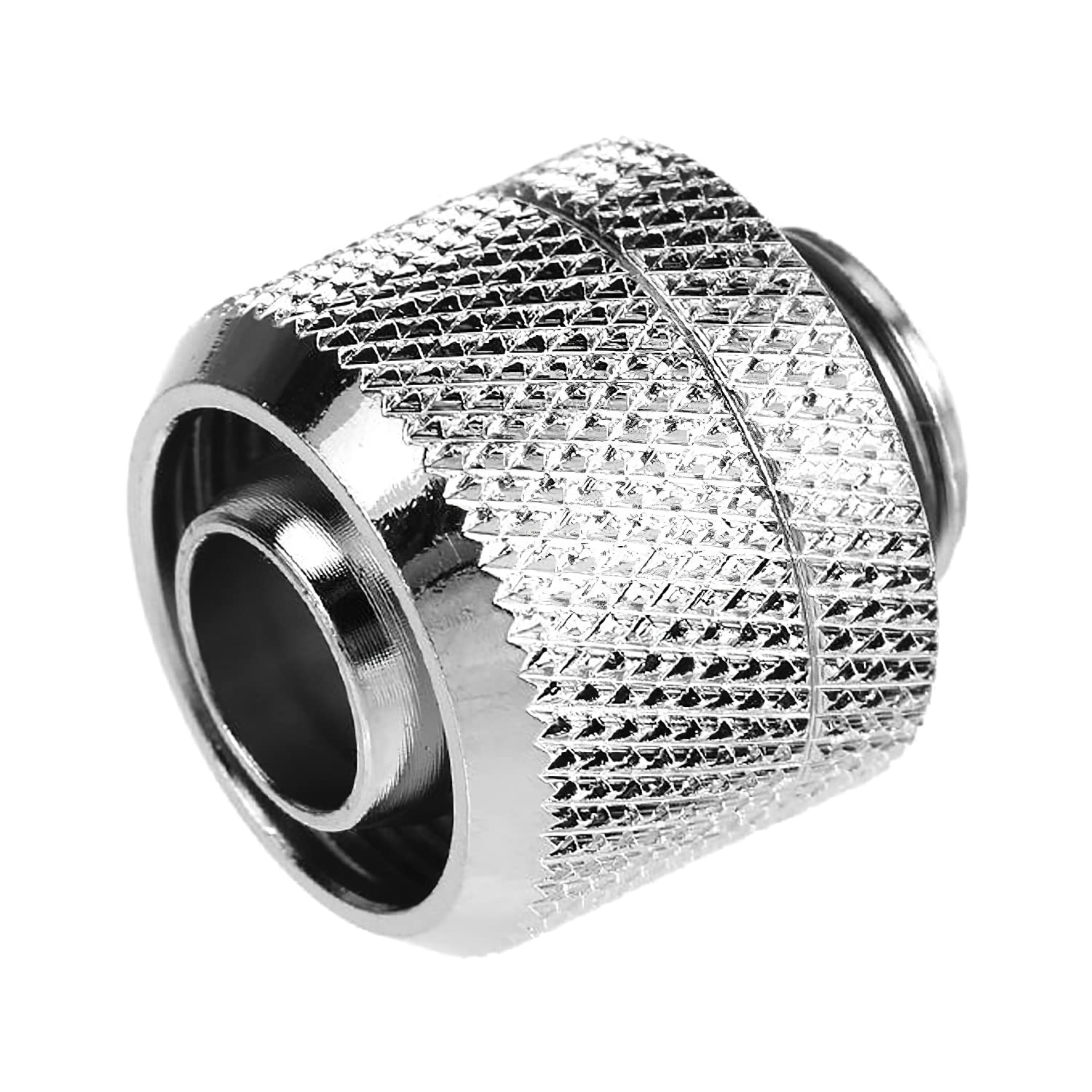
If you’ve spent any time watching custom PC build videos or browsing enthusiast forums, you’ve probably noticed water-cooling loops held together by dozens of small chrome or black connectors — and wondered what every single one of them actually does. Those connectors are fittings: the mechanical interfaces that join your tubing (the flexible or rigid pipes carrying coolant) to your blocks, radiators, pump, and reservoir. Get your fittings right and your loop stays sealed and silent for years. Get them wrong and you’re mopping liquid off a $700 GPU. This guide cuts through the noise and maps every fitting category — compression fittings, rotary elbows, and stop plugs are the big three — to the specific moment in your build where each one earns its place. By the end you’ll know exactly what to order, why, and roughly what to budget.
Why Fittings Are the Part You Shouldn’t Cheap Out On
Custom water cooling is one of those hobbies where the flashy parts (the waterblock, the pump, the radiator) get all the attention — and the humble fittings get ordered last, often from wherever is cheapest. That’s a costly mistake, and not just because of leak risk.
Fittings are the most numerous single component in any loop. A moderately complex build — CPU block, GPU block, 360mm radiator, pump-reservoir combo — easily needs 12 to 20 fittings depending on routing. At $5–$8 per unit for budget brass fittings, or $12–$18 per unit for premium nickel-plated or acrylic options from EK, Alphacool, or Bitspower, that line item adds up fast. Reviewers at Hardware Luxx’s custom water-cooling fittings roundup noted that builders routinely underestimate fitting count by 30–40% on their first loop, which means either a delayed build while you wait on a second order or a compromised routing plan.
Beyond cost, fitting quality determines long-term reliability. The O-ring seated inside a compression fitting — the small rubber seal that actually stops coolant from escaping — degrades faster with off-brand fittings. EK Waterblocks’ custom loop planning guide recommends replacing O-rings every 12–18 months in loops using copper-heavy configurations with aggressive coolants, and every 24 months in simpler aluminum or nickel builds running distilled water with a corrosion inhibitor.
Thread standard is the other landmine. Almost every fitting you’ll encounter uses G1/4” BSP (British Standard Pipe) threading — it’s the de facto universal standard across EK, Alphacool, Corsair, Bitspower, Barrow, and virtually every block manufacturer. Barrow is the notable exception with some proprietary ports on older products, so double-check before mixing brands. Tom’s Hardware’s beginner’s guide to custom water cooling confirms G1/4” as the safe default assumption for any block purchased after 2018.
Compression Fittings: The Workhorses of Every Loop
A compression fitting is exactly what it sounds like: a fitting that compresses a small collar (called a compression ring or ferrule) against the outside of your tubing to create a seal. You slide the collar over the tube end, thread the fitting body into a port, push the tube in until it seats against an internal stop, then tighten the outer collar finger-tight plus a quarter turn. The compressed ring grips the tube mechanically; the O-ring at the base seals against the port. No glue, no clamps, no soldering.
Compression fittings come in two flavors based on what they’re compressing:
Softline compression fittings work with flexible tubing — typically PVC, PETG in flexible form, or silicone. The collar is designed to grip softer material without cracking it. Builders running softline loops (PETG flex or premium Alphacool AlphaTube HF) prize these for their forgiving bend radius and easy rerouting. Igor’s Lab’s hardline vs. softline loop build analysis notes that softline loops take roughly 40% less planning time because you can adjust routing after assembly.
Hardline compression fittings are engineered for rigid tubing — most commonly 12mm or 16mm OD (outer diameter) PETG or borosilicate glass. The inner diameter tolerance is tighter, and many hardline fittings include a small PTFE sleeve or insert to compensate for slight dimensional variation in acrylic or PETG tube stock. EK’s fitting lineup, for example, specifies separate SKUs for 12mm, 14mm, and 16mm OD tube — mixing those up is one of the most common beginner errors.
By the Numbers: Common Tube Sizes and Fitting Compatibility
| Tube OD | Common Pairing | Fitting Thread | Typical Price Range |
|---|---|---|---|
| 10mm (softline) | PETG flex, PVC | G1/4” BSP | $5–$9 per fitting |
| 12mm (hardline) | PETG rigid, acrylic | G1/4” BSP | $8–$14 per fitting |
| 16mm (hardline) | Borosilicate glass, thick PETG | G1/4” BSP | $10–$18 per fitting |
| 19mm (softline) | High-flow silicone | G1/4” BSP | $6–$11 per fitting |
Prices sourced from aggregated retailer listings current to May 2026.
The tradeoff you need to name explicitly: Hardline loops with compression fittings look dramatically cleaner in a showcase build — straight runs, perfect 45° or 90° bends, no kinking. But if you measure a bend wrong and crack a tube, you’re waiting on a replacement length. Softline loops are more forgiving for first timers but harder to route neatly and more susceptible to discoloration over time, particularly with PVC in contact with certain dye-based coolants (Alphacool’s fitting and tubing compatibility reference specifically warns against red dyes in clear PVC, which tints permanently within six months).
Rotary Elbows and Angled Fittings: The Problem-Solvers
Here’s where most intermediate builders leave significant performance and aesthetics on the table. Rotary fittings are compression fittings where the outer body can spin freely after installation — the base is threaded and locked into the port, but the tube-bearing end rotates 360°. A rotary elbow is a rotary fitting bent at 90° (or occasionally 45°); a rotary extender is a straight pass-through that rotates.
Why does this matter? Because in a real case — with a GPU block port facing left, a radiator port facing down, and 40mm of clearance between them — a rigid straight fitting forces an awkward tube run. A rotary 90° elbow lets you connect directly between those two ports with a short, clean tube segment, then rotate the elbow’s outer body to align perfectly after the base is threaded in. Hardware Luxx’s fittings roundup describes rotary elbows as “the single component most likely to convert a messy hardline build into a clean one,” and reviewers there consistently recommend budgeting at least four to six rotary 90° elbows for any hardline GPU-CPU loop.
The cost tradeoff is real: Rotary fittings run $15–$22 each from EK or Bitspower, versus $8–$14 for fixed compression fittings. For a build requiring eight rotary elbows, that’s $60–$70 more than using fixed fittings. The counterargument — and it’s persuasive — is that you’ll spend that money in failed tube bends and reorders if you try to achieve the same routing with straight fittings and rely solely on tube geometry.
Rotary extenders solve a different problem: ports that are deep-recessed inside a chassis or oriented in a direction where a standard fitting body physically can’t thread in without colliding with a case panel. A 30mm or 45mm rotary extender moves the tube connection point outward and lets you rotate it to clear the obstacle. EK’s custom loop planning guide specifically recommends rotary extenders for the inlet and outlet ports on pump-reservoir combos mounted vertically against a rear case panel.
One thing to watch: Not all rotary fittings from different brands are cross-compatible at the rotary joint itself. The G1/4” thread base is universal, but if you’re mixing Bitspower bodies with EK rotary collars (looking for a color match, for example), confirm the outer diameter spec before ordering. Alphacool’s compatibility reference lists outer diameter as 13.8mm for most standard-series fittings, which mates with most collars — but their Eiswasser-series compact fittings run 12.2mm and won’t seat properly in a standard rotary collar.
Stop Plugs: The Unsung Safety Net
A stop plug (also called a blanking plug or fill plug) is a solid G1/4” BSP fitting with no through-hole — it seals a port completely. They’re the least exciting component in a loop and the most important one to order more of than you think you need.
Stop plugs serve three distinct functions:
-
Sealing unused ports. Every waterblock, radiator, and reservoir ships with more G1/4” ports than most builders use. A radiator with four ports needs two for tubing; the other two get stop plugs. Miss one and your loop vents coolant the moment you power the pump.
-
Drain valves. A clever variation is the fill and drain port fitting — a stop plug with an integrated ball valve that stays sealed during operation but opens to let you drain the loop without disconnecting tubing. Bitspower and Alphacool both make premium versions; owners in long-run reviews consistently report these repay their $12–$18 cost the first time you need to swap a component without a full disassembly.
-
Pressure testing ports. Before you ever run coolant through a new loop, experienced builders plug every port except one, connect a hand pump, and pressurize the loop to approximately 15 PSI for 30 minutes. Any fitting that seeps will show immediately — before coolant is involved. Tom’s Hardware’s guide calls this step non-negotiable, and Igor’s Lab’s hardline build analysis echoes it: virtually every leak in a new custom loop occurs at an undertightened fitting or a misseated O-ring that a pressure test would have caught.
If X, then Y — the decision rules:
- If you’re doing hardline PETG and want the cleanest routing: Budget for rotary 90° elbows at every block-to-radiator junction. The extra $60–$80 is cheaper than reordering bent tube.
- If you’re softline and prioritizing ease of first build: Standard compression fittings throughout, but don’t skip fill/drain plugs on the lowest radiator port — you’ll thank yourself at maintenance time.
- If your case has tight GPU clearance (under 50mm between GPU ports and side panel): Rotary extenders plus rotary elbows at the GPU block, full stop. Fixed fittings in that geometry lead to stress on block barbs.
- If you’re on a budget: G1/4” stop plugs from Barrow or Bykski run $1.50–$3 each and use the same thread as premium brands. Compression fittings and rotary elbows are where quality matters; stop plugs for sealed unused ports are fine in budget brass.
Putting It Together: A Practical Ordering Checklist
Before you finalize your cart, count your ports — every single one across every component — then categorize each as: (a) active connection needing a compression fitting, (b) direction-challenged connection needing a rotary elbow, (c) recessed connection needing an extender, or (d) unused port needing a stop plug. Add 20% to your active fitting count as a reorder buffer. Order at least one fill/drain valve regardless of budget.
The fitting decision isn’t glamorous, but it’s where leak-free builds are made or broken. Get this layer of your build right and everything downstream — the coolant, the flow rate, the thermal delta you’re chasing — performs as intended. Reviewers at Hardware Luxx and builders documented in Igor’s Lab’s hardline analysis agree: the loops that fail in year one almost always trace back to an undertightened compression collar or a stop plug that was never ordered at all.
Here’s where you can source these fittings:
EK Quantum Torque Compression Fittings (G1/4” hardline, multiple OD sizes) — our baseline recommendation for hardline builders. If you click through we may earn a small commission; it doesn’t change our pick.
Alphacool Eiszapfen HF Compression Fittings (softline, 10/13mm) — consistently well-regarded in aggregated reviews for O-ring longevity in flexible tubing applications.
Bitspower True Brass Rotary 90° Elbow (G1/4”) — the rotary elbow most recommended in long-run hardline build documentation for its smooth rotation after installation.
Bitspower or Alphacool Fill and Drain Valve (G1/4”) — worth every dollar of the $14–$18 price for any build you plan to maintain past the first year.