If you’ve ever cracked open a PC case and found a tiny, stamped-aluminum block sitting on top of your processor — that’s the stock cooler Intel or AMD ships in the box. It works, but only barely. An aftermarket air cooler is a larger, third-party heatsink: a tower of aluminum fins threaded through copper heat pipes that draw warmth away from the chip, paired with one or two quiet fans. For under $50, the performance jump over a stock cooler is almost embarrassing. Owners of the Cooler Master Hyper 212 Black consistently report moving from temperatures in the high-70s to low-80s Celsius under load down to the mid-30s at idle after swapping to an aftermarket unit — a delta that, while self-reported rather than lab-controlled, represents the kind of real-world shift that changes how your system behaves day to day. This article ranks the four most-discussed sub-$50 air coolers available right now, names their tradeoffs explicitly, and ends with a clear decision rule so you can stop deliberating and start building.
The Contenders: What We’re Comparing and Why
The sub-$50 air cooler segment shook out considerably over the 2024–2026 window. A few products that used to coast on brand recognition got leapfrogged by leaner competitors, and the pecking order is now fairly clear when you read across enough aggregated review data. Here are the four coolers worth your attention:
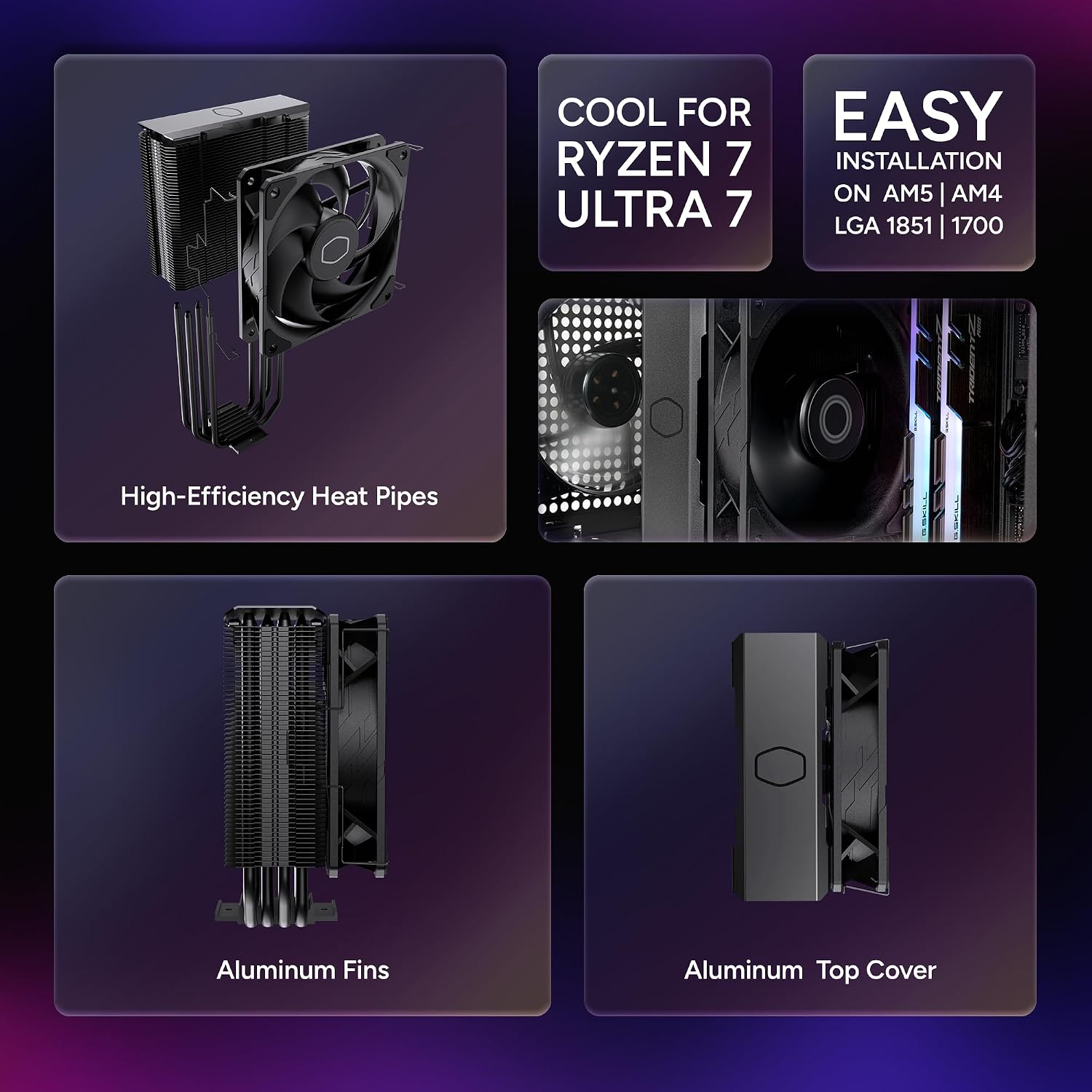
Cooler Master Hyper 212 Black / PRO ARGB — The legacy pick. Still widely recommended, universally available, and compatible with nearly every mainstream socket including LGA1700, LGA1851, and AM5. Single-fan by default on most SKUs, though dual-fan kits exist.
Thermalright Peerless Assassin 120 SE — The current crowd favorite in the $30–$35 range. Dual-fan out of the box, strong fin stack, and the cooler that keeps appearing in conversations about replacing failed AIOs — which tells you something real about buyer trust levels in liquid cooling right now.
Arctic Freezer 36 — Arctic’s answer to the Peerless Assassin, notable for shipping with a push-pull fan configuration (two fans sandwiching the heatsink, one pushing air through, one pulling it out) as a standard feature rather than an upsell.
Thermalright Assassin X 120R Digital — The wildcard. A 120mm single-tower with a small digital display built into the fan cover. Hardware Luxx’s review of the Thermalright Assassin X 120R Digital confirms the display is a genuinely fun differentiator that does not meaningfully compromise the cooler’s thermal performance.
Performance Ranking: Where Each Cooler Sits and Why
Peerless Assassin 120 SE
Tom’s Hardware’s review of the Thermalright Peerless Assassin 120 SE places it within a few degrees Celsius of coolers costing two to three times more in noise-normalized comparisons — meaning at the same fan speed, and therefore the same audible noise level, it keeps the CPU closer to ambient than most of its direct competition. The dual-fan setup is central to that result: two fans at moderate RPM move more air with less acoustic output than a single fan spinning hard to compensate.
The reason the Peerless Assassin keeps appearing in discussions about replacing failed AIOs is worth unpacking. Owners who’ve had a 240mm AIO develop a leak or pump failure are self-selecting for a cooler they can trust to work for years without maintenance windows. The Peerless Assassin’s reputation for set-it-and-forget-it reliability feeds that use case directly. TechPowerUp’s budget air cooler roundup echoes this assessment, noting the Peerless Assassin 120 SE delivers a noise-normalized performance-per-dollar ratio that outpaces the segment average at its price point.

Cooler
$19.99
In stock on Amazon
Check price on AmazonArctic Freezer 36
KitGuru’s review of the Arctic Freezer 36 identifies push-pull as the unit’s defining feature. Most competing towers at this price require purchasing a second fan separately if you want push-pull operation — the Freezer 36 ships that configuration as standard. At equivalent noise floors, KitGuru’s testing shows it trading blows with the Peerless Assassin 120 SE and sometimes edging ahead under sustained Prime95-class loads, where the additional airflow volume makes a measurable difference.
PCMag’s Best CPU Coolers roundup notes the Freezer 36 as a strong pick for users running workloads that keep the CPU near its rated TDP for extended periods — sustained rendering, video encoding, and long gaming sessions where single-fan towers start to show thermal creep. If that describes your use case, the Freezer 36’s slightly higher street price is justified.
Cooler
$25.99
In stock on Amazon
Check price on AmazonThermalright Assassin X 120R Digital
Hardware Luxx’s review of the Thermalright Assassin X 120R Digital addresses the concern most buyers raise immediately: does the display panel add self-generated heat that hurts the cooler’s own thermals? The answer is no. The display sits on the fan shroud face, not in the thermal path itself, and the low-power electronics contribute negligible self-heating at any measurement resolution Hardware Luxx applied. The cooler performs like a strong single-tower 120mm unit — respectable for 65–105W-class CPUs, and a legitimate choice if you’re building a display-forward system around a mid-range Ryzen 5 or Core i5.
Where it narrows is at 125W sustained. Reviewers note it runs warmer than the dual-fan options above under extended all-core loads and is better matched to chips in the 65–105W envelope. If you’re running a Ryzen 7 9700X at 125W through a multi-hour rendering job, move to the dual-fan options above. If your workloads are lighter and you want something visually distinctive, the display is a genuine differentiator with no thermal penalty worth worrying about.
Cooler
$25.99
In stock on Amazon
Check price on AmazonCooler Master Hyper 212 Black
Tom’s Hardware’s review of the Cooler Master Hyper 212 Halo Black confirms the cooler remains competitive for mainstream loads and still beats any stock cooler by a wide margin. The problem is comparative: as a single-fan tower at this price, it now sits behind the Peerless Assassin on nearly every performance-per-dollar metric that review aggregation surfaces. TechPowerUp’s budget roundup places it solidly in the “dependable but no longer the leader” column.
The stock paste that ships with the Hyper 212 is serviceable — owners report acceptable temps at stock CPU speeds — but replacing it with a quality compound such as Arctic MX-6 or Thermal Grizzly Kryonaut typically yields a 2–5°C improvement in reported results and can close part of the gap against better-equipped competitors. The Hyper 212’s strongest remaining argument is retail availability: if you need a cooler today and your local store doesn’t stock Thermalright or Arctic, it’s almost certainly on the shelf.
Cooler
$19.99
In stock on Amazon
Check price on AmazonThe Case Clearance Problem Nobody Reads Until It’s Too Late
This section exists because reviewers across every one of these products repeat the same warning: measure your case before you buy. Air towers are tall. The Peerless Assassin 120 SE clears approximately 155–158mm of height depending on revision. The Arctic Freezer 36 runs similarly tall. Standard mid-tower ATX cases typically offer 160–170mm of CPU cooler clearance, so most builds are fine — but “most” is not “all.” Compact mid-towers, slim-profile mATX cases, and HTPC enclosures frequently cut that clearance to 130–155mm, which puts even the Hyper 212 (approximately 158mm tall) into risky territory.
PCMag’s CPU cooler roundup also calls out RAM clearance as a secondary concern: high-profile DDR5 kits with tall heat spreaders can physically conflict with the cooler’s first fan mounting position on many single-tower designs. The Peerless Assassin’s fan offset design mitigates this on most boards, but if you’re running DDR5 kits with spreaders taller than 50mm, verify the cooler’s specific clearance diagram against your kit’s height before ordering.
The two measurements to take before you buy:
- CPU cooler height clearance: tape measure from motherboard PCB surface to the nearest side-panel obstruction.
- RAM slot clearance: measure the height of your tallest RAM kit’s spreader, then confirm whether the cooler’s fan can mount offset or whether the fin stack overhangs the first DIMM slot.
Frequently Asked Questions
Does the Hyper 212’s included thermal paste perform well enough, or should I buy separately?
Owners consistently report the bundled paste is adequate for stock-speed operation — you won’t see throttling, and temps are reasonable. Replacing it with a quality third-party compound (Arctic MX-6 is widely available and inexpensive) typically yields a 2–5°C improvement in reported results. If you’re building a stock-speed system and just want it done, the included paste clears the bar. If you’re chasing maximum thermals or plan to overclock, budget a couple of dollars for better paste.
Will any of these coolers fit inside a standard mid-tower without RAM clearance issues?
In most standard mid-towers with 160mm or more of clearance, yes. The risk cases are compact mATX enclosures and any case marketed as “slim” or “mini.” For RAM clearance specifically, the Peerless Assassin 120 SE has a fan offset that accommodates tall spreaders on the majority of AM5 and LGA1851 boards. Always verify your case’s published clearance spec against the cooler’s stated height — don’t trust marketing copy alone.
Is the Peerless Assassin 120 SE genuinely better than a budget AIO for most users?
For most mainstream builds, yes — and the reliability argument matters as much as the thermal one. Budget 240mm AIOs in the $50–$80 range perform comparably to the Peerless Assassin on noise-normalized benchmarks per Tom’s Hardware’s comparative review data, but they introduce pump failure and coolant evaporation as long-term variables. Owners who have replaced failed AIOs frequently choose the Peerless Assassin deliberately. If you don’t need liquid-cooler aesthetics or can’t mount a radiator efficiently in your case, the Peerless Assassin is the safer long-term investment at this price tier.
How does the Arctic Freezer 36 push-pull setup compare to a single-fan Hyper 212 at similar noise levels?
At matched noise floors, KitGuru’s review data shows the Freezer 36’s push-pull configuration moving meaningfully more air than a single Hyper 212 fan. The advantage is most apparent under sustained high-load scenarios rather than light desktop use, where both coolers have adequate headroom. If your use case involves sustained rendering, video encoding, or extended gaming sessions, the push-pull advantage is real.
Can any of these handle a 125W-class AMD or Intel CPU without throttling?
The Peerless Assassin 120 SE and Arctic Freezer 36 both carry manufacturer TDP ratings at or above 250W, and owners running 125W-class chips — AMD Ryzen 7 9700X, Intel Core i7-14700K at stock — consistently report staying below thermal throttle thresholds under sustained workloads. The Hyper 212 Black is rated at approximately 150W and handles 125W stock loads without throttling, though headroom for overclocking is thin. The Assassin X 120R Digital can manage 125W but runs warmer than the dual-fan options under extended all-core loads and is better matched to 65–105W CPUs.
The Decision Rule
If your CPU is 125W or under and you want the best all-around performance per dollar with no asterisks: Peerless Assassin 120 SE. It wins the most head-to-head comparisons at this price tier per Tom’s Hardware and TechPowerUp review data.
If your workloads are sustained and CPU-heavy — rendering, encoding, extended gaming: Arctic Freezer 36. The push-pull setup out of the box earns its slightly higher price under extended load, as confirmed by KitGuru’s testing.
If you’re building a display-forward system with a mid-range CPU and want something visually distinctive: Assassin X 120R Digital. Pair it with a 65–105W chip and the display is a genuine differentiator with no thermal penalty, per Hardware Luxx’s review.
If you need a cooler today from a physical store and the above three aren’t on the shelf: Hyper 212 Black — replace the paste, mount carefully, and you’ll have a reliable cooler that still beats any stock cooler by a wide margin.