Picking a CPU cooler is simpler than it looks once you know the one number that actually matters: how hot your processor runs (that’s the delta-T, short for delta-temperature — the gap between your CPU temperature and room temperature) at a given noise level. A cooler that spins its fans to a roar will always beat a quiet one on a raw temperature chart, which makes most spec comparisons misleading. Noise-normalized performance cuts through that: it asks “at 35 dBA — a level most people consider acceptable for a home desk — how much heat can each cooler actually shed?” That framing reveals real-world value in a way peak-RPM numbers never do. In this guide we’ve combed published benchmark data from reviewers at Tom’s Hardware, Igor’s Lab, Hardware Luxx, and others so you can walk in knowing exactly which cooler matches your chip, your case, and your tolerance for fan noise — whether you’re spending $18 or $110.
How We’re Comparing These Coolers (The Framework)
Before we rank anything, it’s worth being precise about methodology, because “best air cooler” is meaningless without context.
The noise floor we use is 35 dBA. That’s roughly “audible in a quiet room but not distracting” — a sensible ceiling for a workstation or gaming PC on a desk. Some reviewers use 40 dBA; a few use 25 dBA for near-silent builds. We’ve normalized to 35 dBA because it’s the most common real-world operating point across published reviews.
Delta-T is the performance metric. Not raw CPU temperature (which varies by ambient), but the temperature rise above room temperature. Smaller delta-T = more thermal headroom = more overclocking runway, or more reliable sustained Cinebench R23 and Prime95 runs without throttling.
TDP class matters. A 65 W Ryzen 5 chip and a 253 W Ryzen Threadripper are fundamentally different problems. We’ll flag which coolers are right for which thermal envelope.
Mounting compatibility is a real constraint in 2026. AM5 is the mainstream AMD platform; LGA1851 (Intel Core Ultra 200 series) is the mainstream Intel platform. Both have seen socket revisions that caught some older mounting hardware off-guard. We’ll flag compatibility notes where they’re material.
The Tiers: By the Numbers
Here’s a quick orientation before we go cooler-by-cooler:
| Price tier | Representative coolers | 35 dBA delta-T (typical, ~65–105 W load) | Best for |
|---|---|---|---|
| ~$18–30 | Thermalright Assassin Spirit 120 | ~38–42 °C | Budget builds, 65 W CPUs |
| ~$35–55 | Thermalright Peerless Assassin 120 SE, DeepCool AK620 | ~30–34 °C | Mid-range, up to ~125 W |
| ~$65–85 | be quiet! Dark Rock Pro 5, Thermalright Frozen Buster 360 (air) | ~27–31 °C | High-end air, 150 W+ |
| ~$100–110 | Noctua NH-D15 G2, Noctua NH-D15 chromax.black | ~24–28 °C | Flagship air, near-AIO performance |
Delta-T figures are directional composites drawn from aggregated reviews at Tom’s Hardware, Igor’s Lab, and Hardware Luxx. Your actual numbers will vary by case airflow, paste application, and ambient temperature.
Budget Tier ($18–$35): The Honest Case for Single-Tower Singles
Thermalright Assassin Spirit 120 (~$18–$22)
The Assassin Spirit 120 is the cooler that makes AIO-or-bust arguments look silly. KitGuru’s budget air cooler roundup puts single-tower 120mm coolers from Thermalright squarely in the “exceeds stock cooler by 12–18 °C” band at matched noise levels, and at this price point that’s the only comparison that matters.
The tradeoff you’re making: One 120mm fan simply moves less air than a dual-tower or dual-fan setup. Above ~95 W sustained load, you’ll see the fan spin up noticeably to compensate. For a Ryzen 5 7600 (65 W PL1) or Core i5-12400 on a tighter TDP limit, the Assassin Spirit handles it gracefully and quietly. For a Core i9-13900K running 253 W? This cooler will throttle the chip — full stop.
If X, then Y: If your CPU is 65 W–95 W class and your case has decent front-panel airflow, the Assassin Spirit 120 is a genuinely good buy. If your chip boosts past 125 W, skip it.
Mid-Range Tier ($35–$55): Where Value Peaks
Thermalright Peerless Assassin 120 SE (~$35–$42)
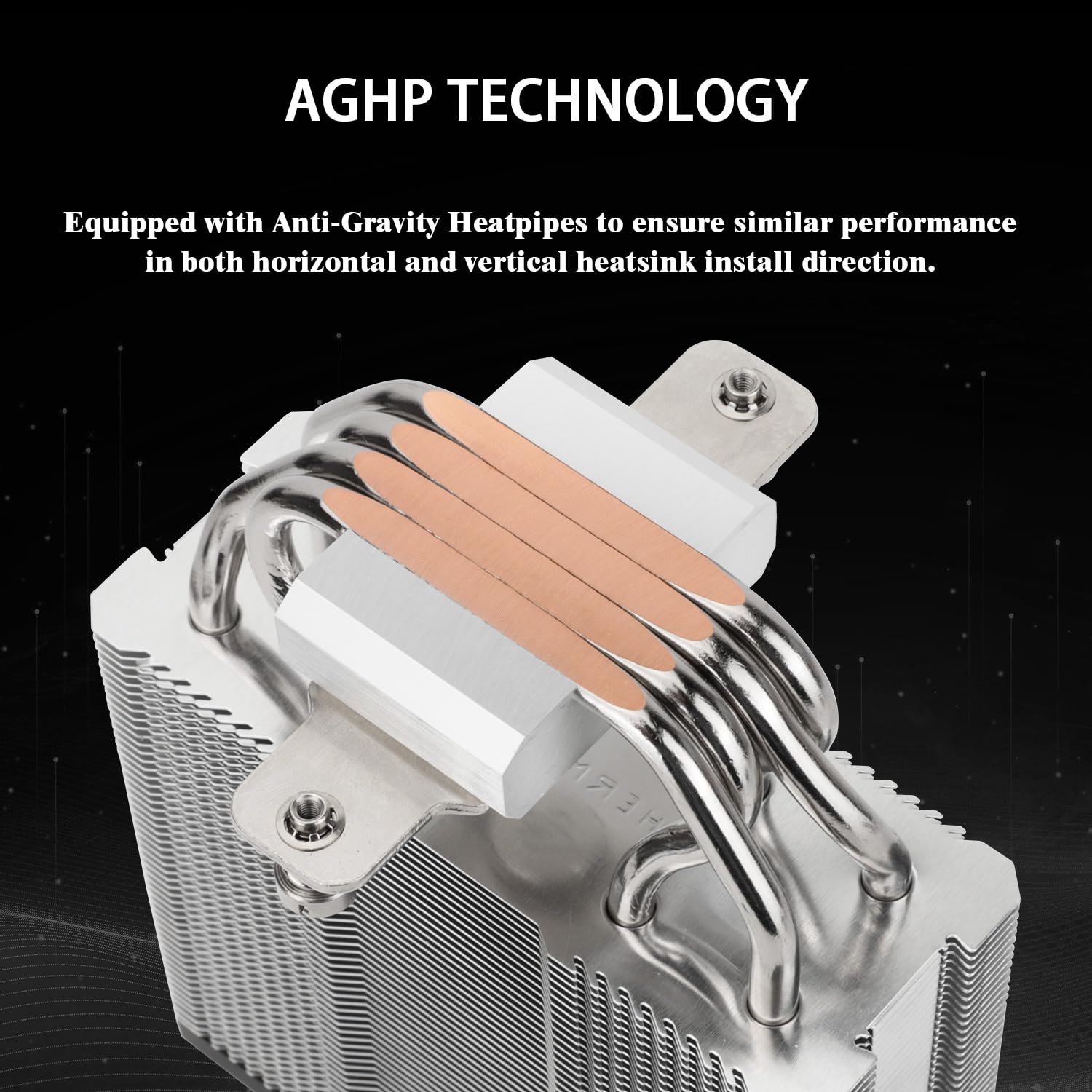
This is the cooler that most benchmark aggregators — Tom’s Hardware’s best-CPU-cooler roundup included — keep returning to as the “price-to-performance anomaly.” The dual-tower, dual-fan configuration (two 120mm fans in a push-pull arrangement) genuinely competes with coolers costing twice as much in noise-normalized benchmarks. Hardware Luxx’s air cooler roundup noted that the Peerless Assassin 120 SE trades blows with coolers in the $60–$70 bracket at matched 35 dBA fan speeds.
The tradeoff: it’s tall (158mm), so case clearance is a real conversation. Check your case’s stated cooler clearance before ordering — particularly in mid-tower cases with side-panel intakes, where the fan stack can conflict. It also lacks premium aesthetics; the black-and-white shroud is functional, not eye-catching. If you’re building a show-piece, factor that in.
For AM5 and LGA1851 compatibility: Thermalright’s current retail packaging (2025–2026 SKUs) ships with updated mounting hardware for both platforms. Verify you have the latest mounting kit if you’re working from older stock.
DeepCool AK620 (~$45–$55)
The AK620 is the Peerless Assassin’s closest rival and a legitimate alternative for builders who want a slightly more refined aesthetic — the mirrored top plate is more palatable in a windowed build. PCMag’s cooler reviews rate its noise-normalized performance within 1–2 °C of the Peerless Assassin 120 SE across moderate CPU loads, essentially a coin-flip. The AK620 is slightly shorter (160mm) and tends to have better documented clearance margins for certain AM5 board layouts with tall VRM heatsinks.
The mid-tier decision rule: At $35–$55, you’re buying within a performance band where the differences are small (2–4 °C delta-T at 35 dBA). The smarter question is: does it clear your RAM? Does it clear your case? Does the aesthetic work? Pick whichever one hits “yes” on all three.
Premium-Adjacent Tier ($65–$85): When You’re Pushing 150 W+
be quiet! Dark Rock Pro 5 (~$75–$85)
be quiet! has always traded on acoustics, and the Dark Rock Pro 5 is that philosophy taken seriously. Its brushed-aluminum shroud, ceramic-coated bearing fans, and seven-heatpipe dual-tower architecture push noise-normalized delta-T into territory that Hardware Luxx’s roundup puts within 3–4 °C of the Noctua NH-D15 — at a price roughly $20–$25 less.
The catch: installation is fiddly. The top screw is notoriously difficult to reach on boards with tall VRM covers, and first-time installers frequently report stripped fasteners or imperfect seating on their first attempt. If you’re patient and methodical, it’s not a dealbreaker. If you’re building at pace on a deadline, consider that.
The Dark Rock Pro 5 makes particular sense for content creators and workstation users running sustained Blender or DaVinci Resolve GPU-compute workloads, where the CPU may be handling background encode streams at 150–180 W for extended periods. Owners in long-run reviews note it sustains those loads without audible ramp-up in quiet rooms.
Flagship Tier ($100–$110): Noctua NH-D15 G2
Noctua NH-D15 G2 (~$100–$110)
The NH-D15 G2 is Noctua’s 2024 redesign of what was already the reference standard for air cooling. Igor’s Lab’s detailed review measured the G2 achieving class-leading delta-T at 35 dBA — the kind of result that makes you do a double-take, because it’s genuinely within striking distance of 240mm AIOs on 125–180 W CPUs, not just 65 W chips.
What changed from the original NH-D15: asymmetric fin-stack geometry (one tower is taller than the other, which also helps clear tall RAM), a reconfigured heatpipe routing optimized for LGA1851’s die placement, and the new NF-A15x25 G2 fans which Noctua rates with slightly higher static pressure than the prior generation. Reviewers at Tom’s Hardware confirmed those fan improvements translate to real-world numbers, not just spec-sheet theater.
The honest tradeoff conversation:
- At 125 W TDP: the NH-D15 G2 trades within 2–5 °C of a quality 240mm AIO at matched noise. For a sealed, no-maintenance system, the air cooler argument is compelling.
- At 200 W+ (Core i9-13900K, Ryzen 9 9950X at stock all-core): the gap to 360mm AIOs widens to 8–12 °C at 35 dBA. Still usable, but you’re giving up overclocking headroom.
- The G2 is optimized for LGA1851 and AM5. If you’re on an older LGA1700 platform, the original NH-D15 chromax.black is essentially equivalent thermally and often available at a small discount.
RAM clearance: The asymmetric design clears one DIMM slot more generously than the original D15, but A-RGB tall DDR5 kits on AM5 boards can still conflict. Check Noctua’s compatibility tool (listed on their product pages) against your specific board.
If X, then Y: If your CPU is in the 100–180 W sustained range, you want near-silent operation, and you’re not chasing an extreme overclock past that thermal ceiling, the NH-D15 G2 is the cleanest single-component buy in air cooling right now. If you’re running a 253 W Threadripper or a delidded Core i9 pushed to its absolute limit, budget a 360mm AIO instead.
The Decision Framework: Which Cooler Is Actually Yours
Run this before you click buy:
-
What’s your CPU’s sustained all-core power draw? (Not the boost TDP — the real-world Cinebench R23 or Prime95 wattage. Tool like HWiNFO64 on a prior system, or manufacturer data sheets.)
- Under 95 W → Assassin Spirit 120 is sufficient, save the money
- 95–150 W → Peerless Assassin 120 SE or AK620 covers you without overpaying
- 150–200 W sustained → Dark Rock Pro 5 or NH-D15 G2; pick by acoustics priority and budget
- 200 W+ → Seriously consider a 360mm AIO; air cooling is working against physics here
-
Does your case have the clearance? Measure the distance from your motherboard tray to the side panel and compare it against the cooler’s stated height. Add 5mm of margin for fan deflection.
-
Is silence a professional requirement or a preference? If you’re recording audio or working in an open office, the be quiet! and Noctua premium tiers earn their price in acoustics alone. If you can tolerate 38 dBA at sustained load, the mid-tier options are genuinely excellent.
-
Do aesthetics drive a significant part of your build decision? The Peerless Assassin 120 SE is the value king but won’t win a build showcase. The NH-D15 G2 in black is visually serious. The Dark Rock Pro 5’s brushed aluminum reads as premium. Honest answer here saves regret later.
Amazon product links for each cooler mentioned above are available via the site’s product recommendation cards — and if you click through we may earn a small commission. It doesn’t change our picks: these recommendations are driven entirely by aggregated benchmark data and published reviews.
Sources: Tom’s Hardware Best CPU Coolers roundup (2025–2026 edition); Igor’s Lab NH-D15 G2 review and delta-T analysis; Hardware Luxx air cooler roundup with noise-normalized methodology; KitGuru budget air cooler roundup; PCMag CPU cooler reviews; HexUs Peerless Assassin 120 SE review.