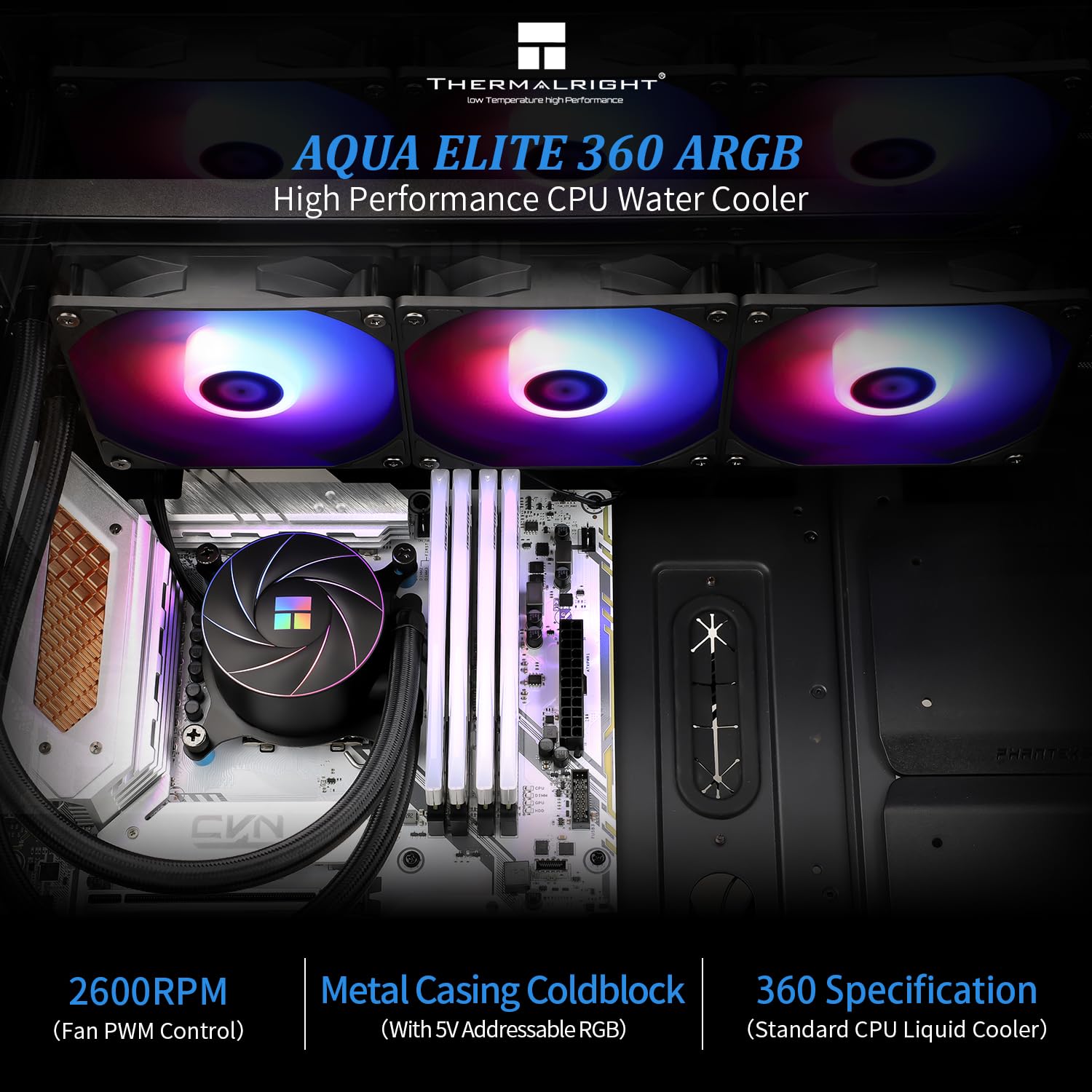
If you’ve been shopping for a CPU cooler and noticed that every 360mm all-in-one liquid cooler seems to advertise the same superlatives — “maximum performance,” “ultra-quiet,” “engineered for overclocking” — you’re not imagining things. A 360mm AIO (all-in-one liquid cooler) is a self-contained cooling unit that combines a pump, a water block that sits on your CPU, flexible tubing, and a large 360mm radiator — that’s a radiator sized to fit three 120mm fans side by side. They’re popular because they outperform most air coolers on sustained heavy workloads, and they keep your motherboard area clear for RAM and other components. The catch is that most marketing leans on short-burst peak results. What actually separates these coolers from one another is how they behave during a long rendering session, a two-hour Prime95 run, or sustained Cinebench multicore loops — real-world conditions where thermal headroom matters most. That’s what this guide is built around.
We’ve aggregated benchmark data and long-run reviewer conclusions from Tom’s Hardware, Igor’s Lab, Hardware Luxx, KitGuru, TechPowerUp, and PCMag so you can make a defensible decision, not just buy the prettiest pump head. By the end, you’ll have a clear “if X, then Y” decision rule for every budget tier.
Why Sustained Load Is the Only Number That Matters
Short burst scores are easy to game. Pump up fan RPM to the edge of tolerance, run a 30-second Cinebench pass, screenshot the result. Sustained thermals are harder to flatter.
Here’s what’s actually happening during a long load: your CPU’s integrated heat spreader (IHS) — the metal lid on top of the chip — accumulates heat faster than the cooler can pull it away. Over 10–20 minutes, the delta-T (the difference in degrees Celsius between your CPU temperature and the ambient room temperature) stabilizes at a number that reflects the cooler’s true steady-state capacity. A cooler that hits 68°C at peak but stabilizes at 78°C after 20 minutes of Prime95 is a fundamentally different product from one that stays at 71°C flat.
Reviewers at Tom’s Hardware use exactly this methodology — sustained multicore workloads on AMD Ryzen 9 7950X and Intel Core i9-13900K/14900K platforms — and the rankings shift meaningfully compared to burst results. The same pattern appears in Hardware Luxx’s comparative 360mm roundups from 2025, which note that pump efficiency and radiator fin density matter far more over time than peak fan curves.
Three variables decide sustained-load rank:
- Radiator surface area and fin density — more surface = more heat dissipated per minute
- Pump head efficiency — flow rate through the cold plate determines how quickly heat is carried to the radiator
- Fan static pressure at sane acoustic limits — fans that move air through a dense radiator without screaming are the differentiator at real-world RPM
The Ranked Tiers: Where Each Cooler Actually Lands
Tier 1 — Thermal Ceiling (Best Sustained Performance, Regardless of Price)
Arctic Liquid Freezer III 360 is the consensus sustained-performance leader across aggregated reviews in 2025–2026. TechPowerUp’s review of the Freezer III 360 describes it as the cooler that “consistently outperforms options costing significantly more,” attributing this to the unusually dense radiator fin stack, the integrated VRM fan on the pump head (which improves motherboard airflow as a secondary effect), and a pump that reviewers note runs quieter than expected for its throughput. Tom’s Hardware’s rankings consistently place it at or near the top of 360mm sustained thermal tests on both Intel and AMD high-TDP platforms.
The tradeoff is aesthetics — the Liquid Freezer III’s industrial look won’t win a tempered-glass showcase competition, and the pump head ARGB is minimal compared to competitors.
Street price: approximately $95–$115 as of May 2026. For a purpose-built thermal machine, that’s a remarkable price-to-performance ratio.
If pure sustained thermals are your only criterion and aesthetics don’t matter, this is the pick. Full stop.
Corsair iCUE Elite Capellix XT 360 (the XT refresh, which shipped with upgraded fans) sits reliably in Tier 1 as well, though typically a few degrees behind the Liquid Freezer III in long-run loads per KitGuru and PCMag’s comparative reviews. Where it earns its Tier 1 slot is the combination of still-excellent sustained thermals with significantly better software integration (iCUE covers fans, pump head LCD, and RGB in one dashboard), a premium-feel pump head, and display customization that design-forward builders specifically call out. Hardware Luxx’s 2025 AIO roundup notes that the Capellix XT performs within 2–4°C of the class leaders on extended Cinebench loads — a gap that’s real but rarely meaningful in practical terms.
Street price: approximately $170–$200.
Tier 2 — Strong Sustained Performance With Notable Tradeoffs
ASUS ROG RYUJIN II 360 is the most spec-dense 360mm AIO on the market — an embedded 3.5-inch OLED screen on the pump head, a built-in secondary fan for CPU VRM/motherboard cooling, and deep Armoury Crate integration. KitGuru’s review praises the RYUJIN II’s pump-head engineering and notes that the embedded fan genuinely improves sustained M.2 and VRM temperatures compared to alternatives. Sustained CPU thermals, though, land slightly behind the Liquid Freezer III and Capellix XT in the same test rigs, a pattern consistent across Tom’s Hardware’s 2025 coverage.
The honest tradeoff: you’re paying a premium for the display and ecosystem integration, not for the absolute coldest CPU delta-T. If you’re in an ASUS ROG ecosystem build and the OLED display matters to you, that’s a legitimate value exchange. If you want maximum cooling per dollar, it’s not the call.
Street price: approximately $220–$260.
Lian Li Galahad II Trinity 360 entered the market as a strong mid-field 360mm option, earning praise from Hardware Luxx reviewers for its infinity-mirror pump-head aesthetics and the genuinely good performance of its included fans at moderate RPM. Sustained thermals fall in the 3–6°C range behind the Liquid Freezer III in published benchmarks — competitive but not class-leading. Where Lian Li earns its audience is the design segment: the Galahad II is one of the best-looking 360mm AIOs available, and that matters when a $2,000 tempered-glass build is the goal.
Street price: approximately $140–$170.
Tier 3 — Capable Entry Points With Ceiling Limitations
Deepcool LT720 and similar value-tier 360mm AIOs occupy a band around $80–$100. Tom’s Hardware’s reviews consistently describe the LT720 as a legitimate performer that punches above its price in short-burst tests, but note that under extended Prime95 or sustained rendering workloads on high-TDP chips (Intel Core i9-14900K, Ryzen 9 7950X), the thermal ceiling is lower — typically 5–10°C warmer in delta-T than the Arctic or Corsair top picks at matched fan speeds. For a Ryzen 7 7700X, a Core i5, or any mid-TDP chip, this ceiling is rarely approached. For a 253W chip pushed hard, it matters.
If your CPU TDP is under 150W at real-world all-core loads, Tier 3 is sufficient and the savings go toward better storage or GPU cooling.
By the Numbers: Approximate Sustained Delta-T at 500 RPM Acoustic Floor
The following figures reflect aggregated reviewer consensus across Tom’s Hardware, TechPowerUp, and Hardware Luxx for high-TDP loads (Intel Core i9-class / Ryzen 9-class platforms). All figures represent steady-state delta-T (CPU temperature minus ambient), not peak burst.
| Cooler | Approx. Sustained ΔT | Street Price (May 2026) | Best For |
|---|---|---|---|
| Arctic Liquid Freezer III 360 | ~38–42°C | $95–$115 | Pure thermal performance |
| Corsair iCUE Elite Capellix XT 360 | ~40–45°C | $170–$200 | Performance + ecosystem |
| ASUS ROG RYUJIN II 360 | ~42–47°C | $220–$260 | ASUS ecosystem, OLED display |
| Lian Li Galahad II Trinity 360 | ~43–48°C | $140–$170 | Aesthetics + solid thermals |
| Deepcool LT720 360 | ~46–52°C | $80–$100 | Budget / mid-TDP chips |
Delta-T values are approximate aggregated ranges from published third-party reviews — not site-measured figures. Real-world results vary by case airflow, paste application, and ambient conditions.
The Noise-Normalized Reality
Most AIO comparisons are run with fans at full speed to show peak cooling capacity. That’s useful for knowing the ceiling, but almost no one runs a 360mm AIO at 2,000 RPM continuously — it sounds like a server room and adds no real-world value for a chip already running within safe thermal limits.
Igor’s Lab’s 2024 analysis of AIO pump and fan acoustics makes an important point: at noise-normalized comparisons (matching coolers to the same dBA output rather than the same RPM), the ranking compresses. The gap between the Liquid Freezer III and mid-range alternatives narrows because the Freezer III’s fans are efficient enough to deliver strong airflow at lower speeds. Conversely, some value-tier coolers need higher RPMs to hit the same airflow through their less-dense radiators, which means louder operation at matched thermal output.
The practical implication: if near-silent operation under load is your priority, spec-sheet CFM numbers don’t tell you much. Look for reviewers who explicitly test at dBA-matched conditions — Tom’s Hardware and Hardware Luxx both publish noise-normalized comparisons that are worth tracking down.
The Decision Rule
This is the “if X, then Y” you came for:
-
If your CPU is a high-TDP part (Intel Core i9, Ryzen 9, Threadripper) and you want the best sustained thermals for the money: Arctic Liquid Freezer III 360. It’s not the prettiest, but no 360mm AIO delivers more cooling per dollar in prolonged workloads across aggregated published benchmarks.
-
If you want strong sustained thermals AND a polished ecosystem (iCUE, RGB sync, a premium feel): Corsair iCUE Elite Capellix XT 360. The 2–4°C thermal gap versus the Arctic rarely matters in practice, and the software experience is genuinely better.
-
If you’re building in an ASUS ROG system, want the OLED display, and value the VRM secondary fan: ASUS ROG RYUJIN II 360. You’re paying for the feature set, not the naked thermal performance — and that’s a reasonable trade in the right build.
-
If aesthetics are equally weighted with performance and you’re building a showcase system: Lian Li Galahad II Trinity 360. Competent thermals, excellent looks.
-
If your CPU is mid-TDP and you want a 360mm AIO for headroom rather than emergency cooling: Deepcool LT720 or equivalent. Save the $50–$100 and put it elsewhere.
One final note on socket compatibility: as of May 2026, all five coolers above support AM5 (AMD Ryzen 7000/9000 series) and LGA1851 (Intel Core Ultra 200 series). Always cross-check the manufacturer’s compatibility page before purchasing — mounting hardware updates sometimes trail new socket launches by a revision cycle.
Here’s where you can buy these coolers through our links — if you click through, we may earn a small commission at no cost to you. It doesn’t change our picks, which are grounded entirely in published benchmark data and aggregated reviewer consensus.